




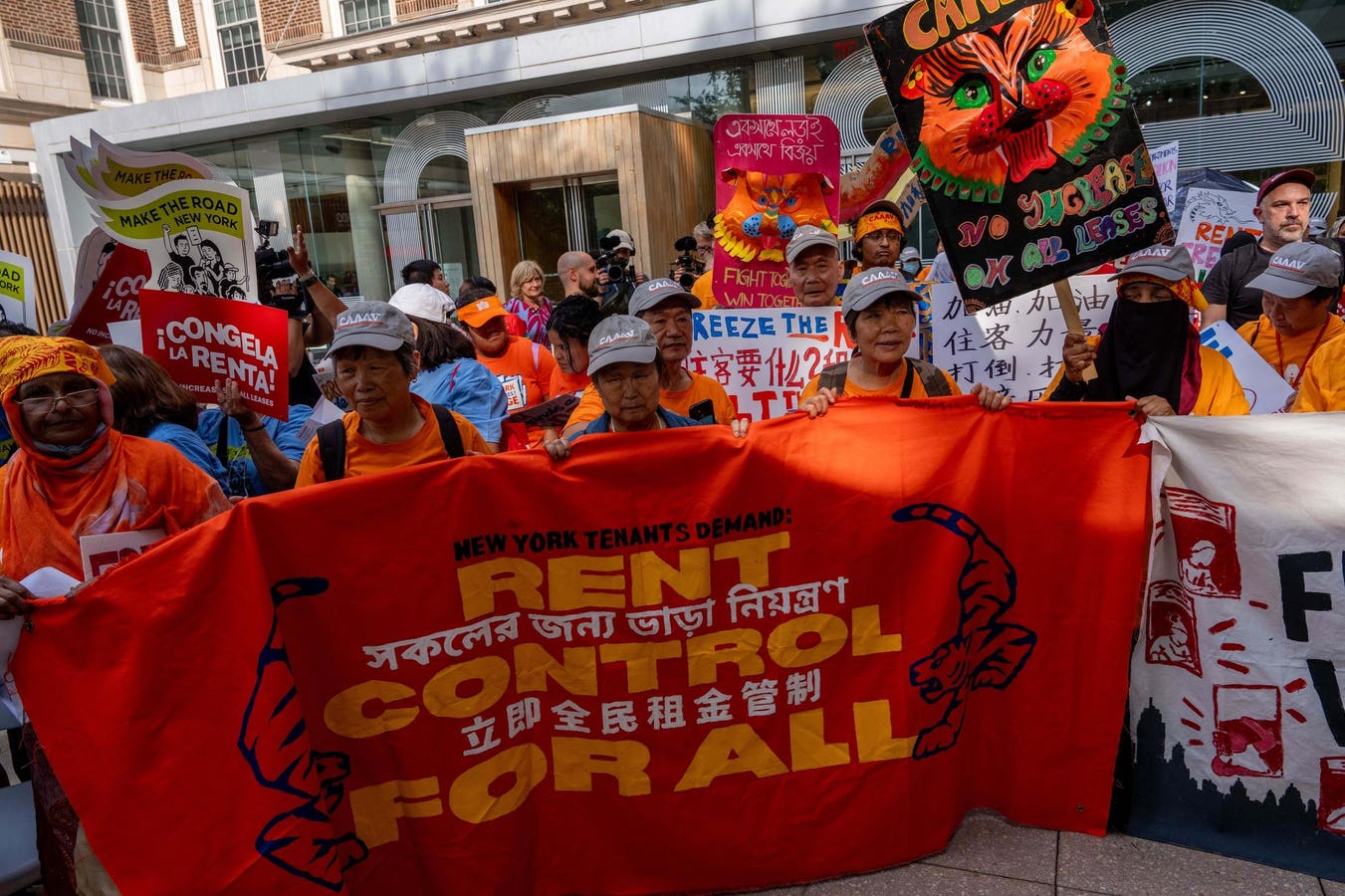
All the arguments for and against rent control miss this little fact. The wealthiest sometimes really like the arrangement when they get to benefit from it, and don’t own apartment buildings where the regulations put financial constraints on them.
The original article from the Wall Street Journal (here’s a gift link from me so you don’t need a subscription) was mildly mind-blowing. Rent control is something many people associate with lower-income tenants, not people who are better off. Perhaps this is something specific to New York City, where there are long-standing tropes of people having occupied rent-controlled apartments for long enough to build a career and watch as the gap between market and rent-controlled prices can expand, leaving the renter with a better deal year after year.
The Journal called making a six-figure salary while paying half the market rate an “urban legend” for most New Yorkers. But not absolutely unknown. The outlet analyzed the most recent available figures from the New York City 2023 Housing and Vacancy Survey.
They found that of people living in rent-stabilized apartments, the top 25% of earners paid $1,000 less each month in median rent compared to market-rate units, making their savings about a third in shelter costs. The top 10% of earners save $1,300, or a 36% discount.
In comparison, rent-stabilized tenants from the lowest three income quartiles get a price break of about $300 from market rates.
Rent-stabilized is separate from rent-controlled. The former is controlled by the city; the latter, by the state.
Breaking it out with more detail, from the fourth income quartile (wealthiest) to the first (least income and wealth), the market rate for the fourth income quartile is $3,000, while the stabilized rent is $2,000. Market rate for the third quartile is $2,000, with the stabilized rate of $1,673.35. For the second quartile, the market rate of $1,700 compares to the stabilized rate of $1,414.44. And for the first quartile, market rate is $1,513.42, compared to the stabilized rate of $1,190.33.
The situation isn’t new. In 2019, the Journal wrote about the same dynamic. The rental gremlin is the structure of the rules, in effect in varying forms since World War II. A board appointed by the mayor sets maximum permitted rent increases for one- or two-year leases.
In more expensive neighborhoods, where wealthier renters tend to be, rents are higher, and so the stabilized housing is much cheaper in comparison, given the composition of the rules. Also, the system doesn’t typically test for income.
“You do have people paying $5,000, $6,000, or $8,000 for rent-stabilized apartments,” Allia Mohamed, CEO of rental data firm Openigloo.
As one might imagine, rental costs vary widely across the five boroughs: Manhattan, Brooklyn, Queens, Staten Island, and the Bronx.
Manhattan’s market rate is $3200, with a stabilized rate of $1,666.92. The market rate in Brooklyn is $1,975, compared to a stabilized rate of $1,505. In Queens, market is $1,900 and stabilized is $1,645. Staten Island has a $1,800 market rate and a stabilized rate of $1,354. Finally, the Bronx market rate is $1,435.50, while the stabilized rate is $1,263.49.
This boils down to disagreements between landlords and affordable housing advocates. “This shows you the system is malfunctioning,” New York City real-estate attorney Massimo D’Angelo, who represents private landlords, told the Journal. “We need to give these apartments to people who actually need them.” That approach would also likely mean fewer stabilized units, because lower-income people might find even the lower prices expensive.
On the other side is Darius Khalil Gordon, executive director for the Metropolitan Council on Housing. “This isn’t a welfare program,” Gordon told the Journal. “That’s not what rent stabilization is. We’re not looking out for just the most needy. It’s made to make sure that people can afford to live in a city that they love.”
As the paper reported, the average two-bedroom in Midtown East runs about $7,500 a month, 17% higher than in 2025 according to real estate data firm Zumper. That sort of increase could pinch even some higher incomes. Still, data from the Citizens Budget Commission showed that about 10% of all the rent-stabilized housing stock is upper-income, with 86,70 earning more than $200,000 a year.
Read the full article here